

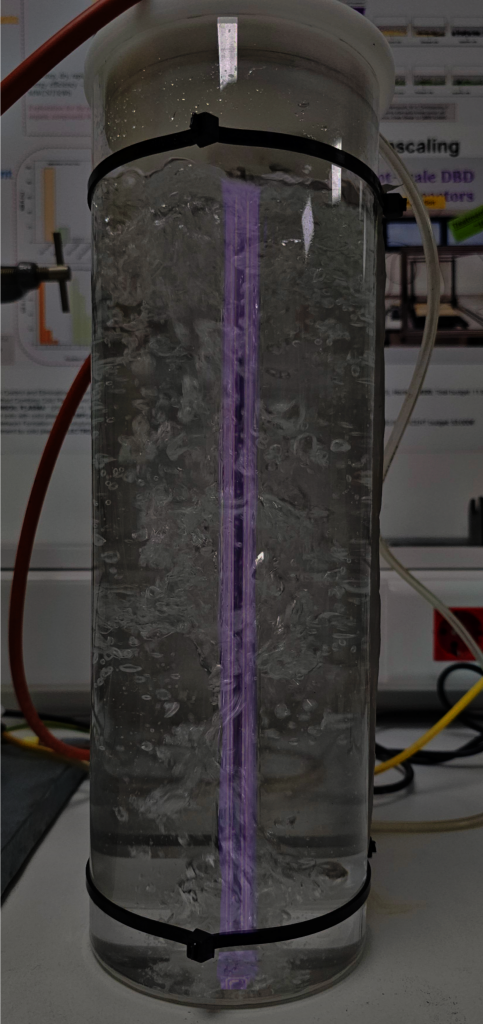
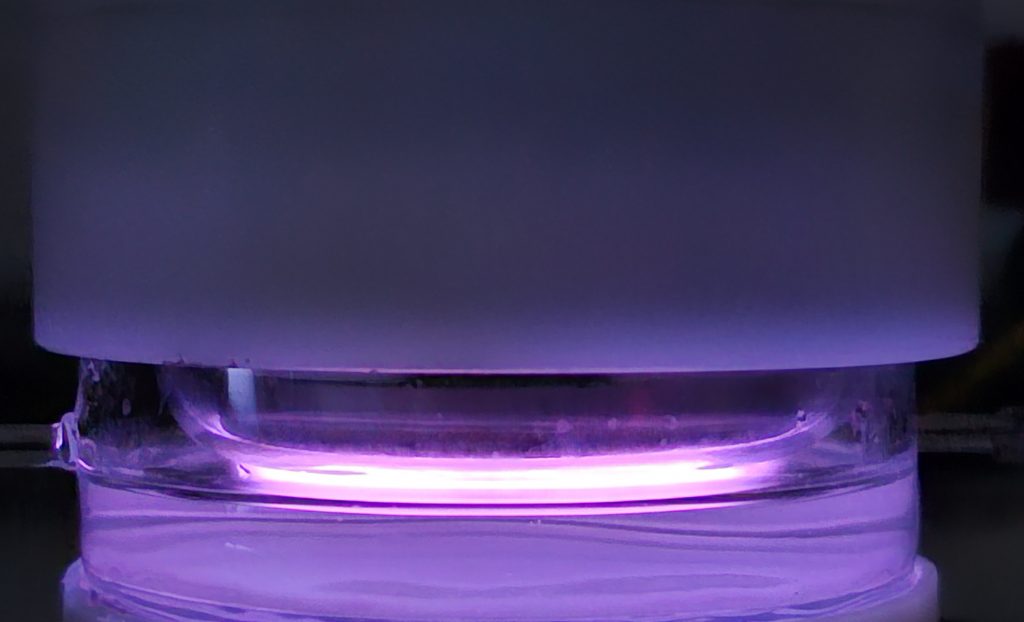
Lab-scale studies of several plasma configurations (gas-liquid DBD and corona, plasma bubbles) for the degradation of various organic pollutants (e.g. PFAS, antibiotics, dyes) in aqueous solutions. Inactivation of bacteria by cold plasma. Process optimization and exploration of plasma and pollutant degradation mechanisms
Cold Plasma and Advanced Techniques for Improving Environmental Systems Laboratory
Welcome to PlaNET Lab
The Laboratory of Cold Plasma and Advanced Techniques for Improving Environmental Systems (PlaNET) within FORTH/ICE-HT structure began its research activities in 2018.
PlaNET’s mission is to advance plasma-based research with applications in environmental and industrial challenges. Its work spans fundamental studies in plasma physics and chemistry to the development of plasma reactors at both laboratory and pilot scales.
The laboratory’s core research areas include:
(i) Soil and waste remediation
(ii) Wastewater treatment
(iii) Plasma characterization and characterization of plasma-activated water
(iv) Adsorbent activation and regeneration for wastewater treatment
Additionally, PlaNET explores the potential of non-thermal plasma in food decontamination, biomass valorization, materials functionalization, and cancer treatment.
PlaNET serves as a bridge between fundamental research and large-scale industrial applications. Equipped with state-of-the-art facilities, it is well-positioned to support its research and development activities.
PlaNET’s long-term vision is to establish a comprehensive research framework that integrates non-thermal plasma with other scientific approaches. This framework aims to develop sustainable, cost-effective, and scalable solutions for environmental restoration. At the same time, PlaNET is committed to unlocking the full potential of non-thermal plasma technology across diverse research fields.
Research Activities
Lab-scale study and numerical modeling of NTP as a method for the advanced oxidation of recalcitrant pollutants (e.g. PFAS, petroleum cuts, pesticides, pharmaceuticals) in contaminated soil. Appropriately configured plasma lab-scale reactors to produce discharges above and/or directly inside the pore space of soils. Process optimization and exploration of plasma and pollutant degradation mechanisms
Materials and catalysts surface modification/activation for potential use in organic pollutants’ removal/determination. Regeneration of spent adsorbents by cold plasma techniques
Catalysis-assisted plasma treatment for soil and wastewater remediation
Measurement of plasma species in aqueous solutions (OH radicals, O3, H2O2, NO3-, NO2-, etc.), pH, ORP, electrical conductivity
Valorization of agricultural wastes for the development of low-cost adsorbents capable to remove multi-species pollutants from wastewater
Process optimization and critical plasma species identification towards cancer cell apoptosis
Current-voltage (I-V) waveforms and determination of plasma power, optical emission spectroscopy (OES) for the identification of plasma excited species in the gas phase
Chemical oxygen demand (COD), total oxygen demand (TOC), high performance liquid chromatography (HPLC) and UV-Vis spectroscopy
Water hardness by determining concentrations of calcium and magnesium ions, assessment of nutrient levels, such as nitrogen and phosphorus compounds, total suspended solids (TSS), colorimetric analysis